Because facial anatomy varies, and an average is a poor substitute for looking.
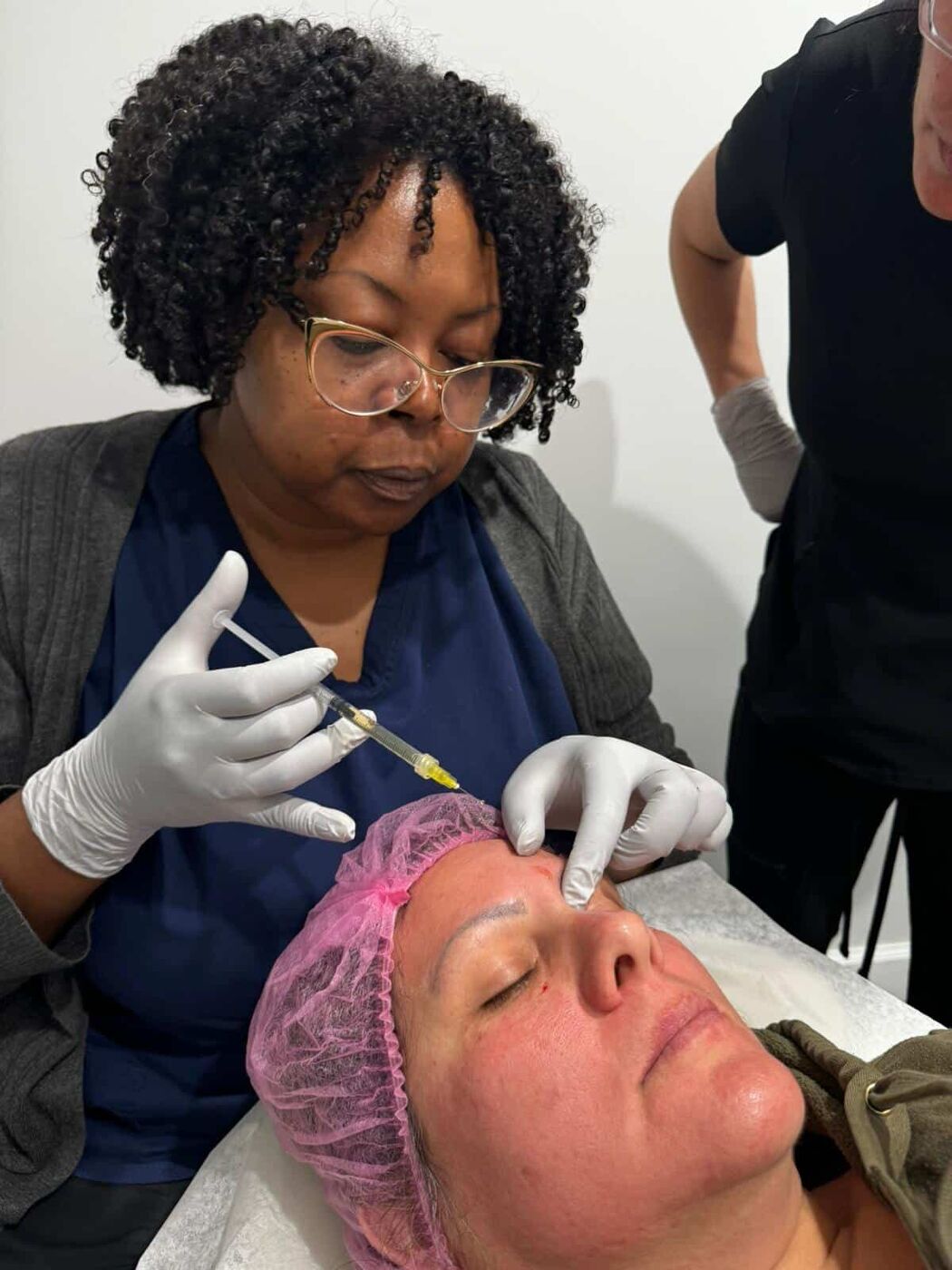
Ultrasound offers a non-invasive, radiation-free view beneath the skin. Depending on the clinical situation, it may assist with evaluating facial anatomy, identifying important blood vessels, assessing existing filler, evaluating lumps or nodules after cosmetic procedures, guiding filler dissolving when appropriate, supporting ultrasound-guided injections, evaluating superficial veins, and enhancing treatment planning.
Most aesthetic injecting is planned from surface landmarks and population averages. Those averages are useful, and they are also only averages — the vessels in your face sit where they sit, not where a diagram says they should. Imaging closes that gap for the areas where it matters.

Identifying important blood vessels in the area being treated, so placement is planned around your anatomy rather than a textbook average.
Evaluating the presence and location of previously placed dermal filler — including filler placed elsewhere, years ago, by someone else.
Supporting ultrasound-guided injection, and guiding filler dissolving when that is the appropriate course of action.
Evaluating lumps or nodules after cosmetic procedures, and helping plan appropriate management for what is found.
Ultrasound technology is only one part of the equation. Accurate interpretation requires experience. Dr. Lawson combines years of expertise performing image-guided procedures with aesthetic medicine to provide physician-led evaluations focused on precision, safety, and personalized care.
This is the part that does not transfer with a purchase order. A practice can buy a machine; reading what is on the screen is a separate skill, built over a career of image-guided work. Dr. Lawson is double board-certified in vascular and interventional radiology and has practiced in South Florida since 2013. Read her background.
It is not used for every cosmetic procedure. It is used selectively, when it may improve evaluation, planning, or image-guided treatment — and saying so matters, because imaging sold as a routine add-on stops being a clinical decision.
It does not guarantee an outcome. Real-time visualization may improve procedural precision in selected situations, and it serves as one component of a comprehensive physician-led approach to patient safety, not a replacement for judgment, technique or careful patient selection.
It does not read the same for every product. Findings vary by filler type and by clinical circumstance, so what a scan can tell you about old filler depends on what was placed and how long it has been there.
And it does not mean other injectors are doing something wrong. A great deal of aesthetic treatment is performed safely without imaging. Ultrasound is additional information, used here because interpreting it is the work Dr. Lawson trained in.
In practice, imaging sits in front of the treatments rather than beside them. Facial ultrasound supports dermal fillers and facial balancing, Sculptra and PDO threads, and it is the appointment to book if filler placed elsewhere needs identifying or dissolving. Vein ultrasound sits in front of spider vein treatment and sclerotherapy.
Patients come to the Flamingo Road practice from Cooper City, Davie, Weston, Pembroke Pines and Southwest Ranches, and ongoing treatment plans are covered by membership pricing.

Dr. Lawson teaches this material to other licensed injectors through the Ivy Ultrasound Academy — foundations, facial anatomy and vascular mapping, then complication assessment and advanced applications.
Explore aesthetic training →Aesthetic ultrasound uses sound waves to visualize facial tissues beneath the skin in real time without radiation.
No. It is used selectively when it may improve evaluation, planning, or image-guided treatment.
Real-time visualization may improve procedural precision in selected situations and serves as one component of a comprehensive physician-led approach to patient safety.
No. Ultrasound uses sound waves and does not expose patients to ionizing radiation.
No. Ultrasound is non-invasive and generally painless, requiring only a small amount of gel on the skin.
No. Most aesthetic treatment is performed safely without imaging. Ultrasound is an additional source of information, and this practice uses it because interpreting it is what Dr. Lawson trained to do.
Book a consultation and find out whether ultrasound evaluation would change your treatment plan.
Reviewed by Ivy Lawson, MD · Physician — Vascular & Interventional Radiology · Last reviewed September 2026. About Dr. Lawson